
How do environmental conditions influence wine tasting?
On more than one occasion, we’ve encountered that seemingly simple question that actually hides a whole world of nuances: how do ambient conditions influence wine tasting? We’re not talking about unimportant subtleties. We’re talking about elements that can completely transform the sensory experience. Because if there’s one thing those of us dedicated to the world of wine know, it’s that every detail matters. A lot.
It’s not just about the wine in the glass, but the surroundings. We’re referring to the temperature, the aromas in the air, the light, and even the sounds. Everything has an impact. And when we say everything, we mean everything. In this article, we’re going to break down how each of these ambient conditions can influence—or enhance—a wine tasting. Because no, tasting a glass in a well-appointed room is not the same as tasting it on a terrace in the middle of a festive celebration.
The nose rules: smells in wine tasting
If we start from the beginning, the first thing activated during a wine tasting isn’t always sight. It’s smell. The olfactory phase is key to evaluating any wine, and if there are interfering odors in the environment, we’re lost.
Intense perfumes, air fresheners, cleaning products, or even the fragrance of a candle can alter our perception of a wine’s aroma. And the truth is, the brain can’t easily distinguish whether that coconut aroma comes from the white wine we’re tasting… or from the fabric softener on the neighbor’s sweater. Therefore, a tasting room should be as olfactory-neutral as possible.
It’s no coincidence that professional tasting spaces are well-ventilated, clean, and free of aromatic distractions. The sense of smell needs to work clearly. And to do that, we must allow it to do so.
At this point, it’s interesting to learn more about how the human sense of smell works; you can learn more in this Wikipedia article on smell.
How does light affect wine tasting?
Although sight isn’t everything, it is our first impression of a wine. We evaluate its color, brilliance, clarity, and even its visual intensity. But this is only possible if the lighting conditions are right.
Very warm light can alter the nuances of a red wine, making it appear more aged or less brilliant. Conversely, too white or artificial light can dull the golden reflections of a good barrel-fermented white wine. The key is to find a balance: natural or neutral white light, indirect, without harsh shadows. And of course, always avoid colored lights, harsh spotlights, or any type of unnecessary lighting effect.
Furthermore, excessive light or heat on the bottle can alter the wine even before it’s served. Wine is sensitive, and we must treat it with care, even on a visual level.
The invisible enemy: noise and sound in wine tasting
We don’t usually think about it, but the sound environment has a huge impact on our ability to concentrate. A wine tasting requires attention. And if there are external noises, cross conversations, or loud music, the brain wanders.
A complex wine, with subtle aromatic nuances and a delicate palate structure, deserves silence. Or at least, a quiet environment. It’s impossible for us to capture the elegance of a Crianza wine if an industrial coffee maker is whirring next to us or someone is commentating on Sunday’s soccer match.
That’s why we insist that tasting spaces should, above all, be calm spaces. If sound can’t be eliminated, at least control it: soft instrumental music, echo-dampening materials, and silent phones. The wine will appreciate it. And so will our senses.
What you can’t see but can feel: temperature in wine tasting
We’ve reached one of the great classics: temperature. But we’re not just talking about the temperature of the wine, but also the ambient temperature. Because yes, both have a decisive influence.
A red wine served above 22°C can become flat, alcoholic, and heavy. An excessively chilled white wine can lose its fruity notes and simply seem acidic. But if we’re also in an overheated or too cold room, our senses don’t function at their best. Taste perception is affected by the thermal environment, and this influences our evaluation of the wine.
Therefore, the ideal is to keep the room between 18 and 22°C, and serve wines at their ideal temperature. A temperature that’s pleasant for the body is also an ally for the palate.
The importance of the physical environment: colors, materials and furniture
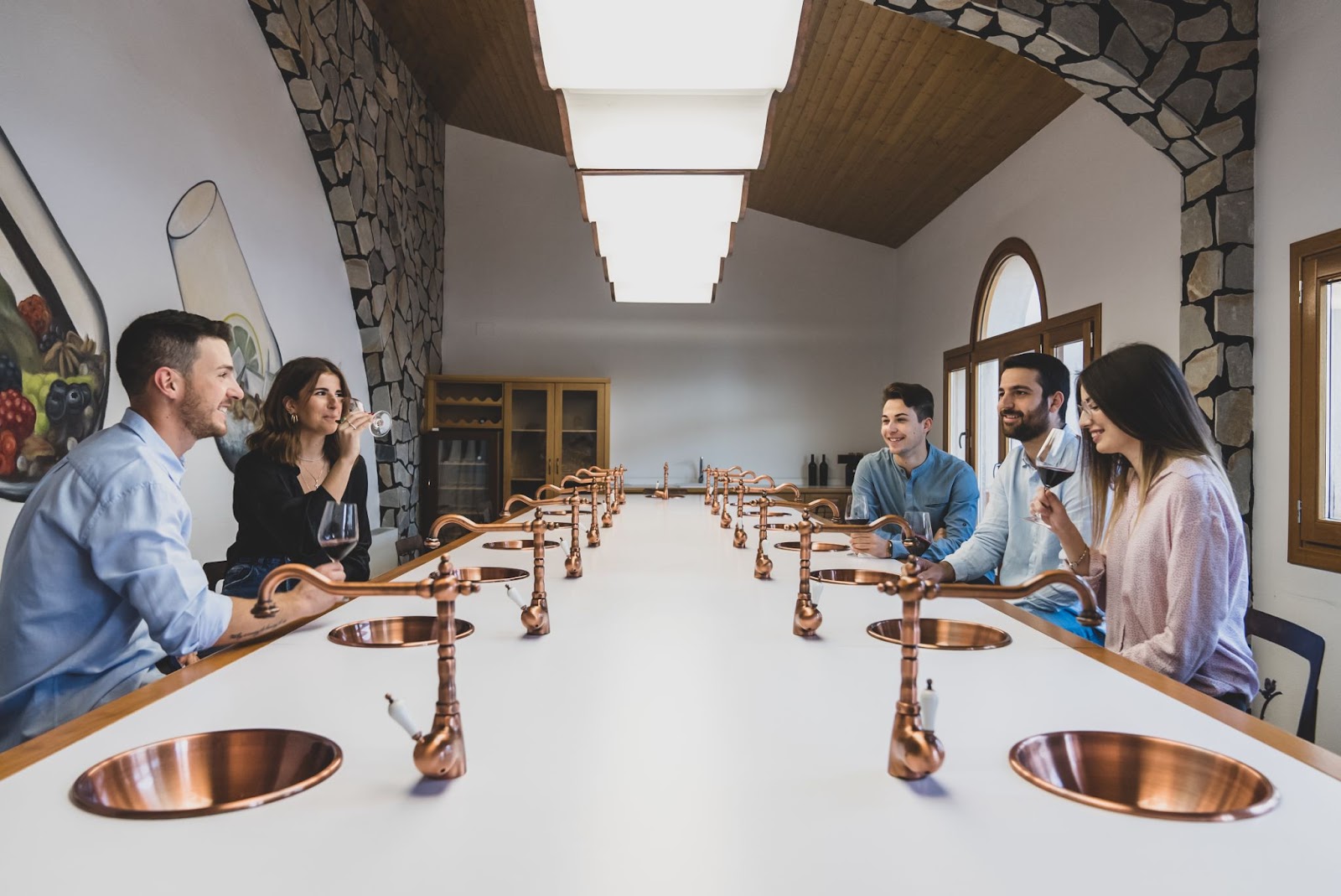
Although it may seem like a minor detail, furniture also plays a role. A wine tasting is not the place for brightly colored tables or patterned tablecloths. We need neutral backgrounds that allow the wine‘s true color to be appreciated. White is the most common choice, precisely because of its neutrality.
Comfort is also important: an ergonomic chair, a table at the right height, and the right glass allow us to focus on what’s essential: the wine. It’s not just a question of aesthetics; it’s a question of functionality.
Environmental psychology: How does our environment influence us?
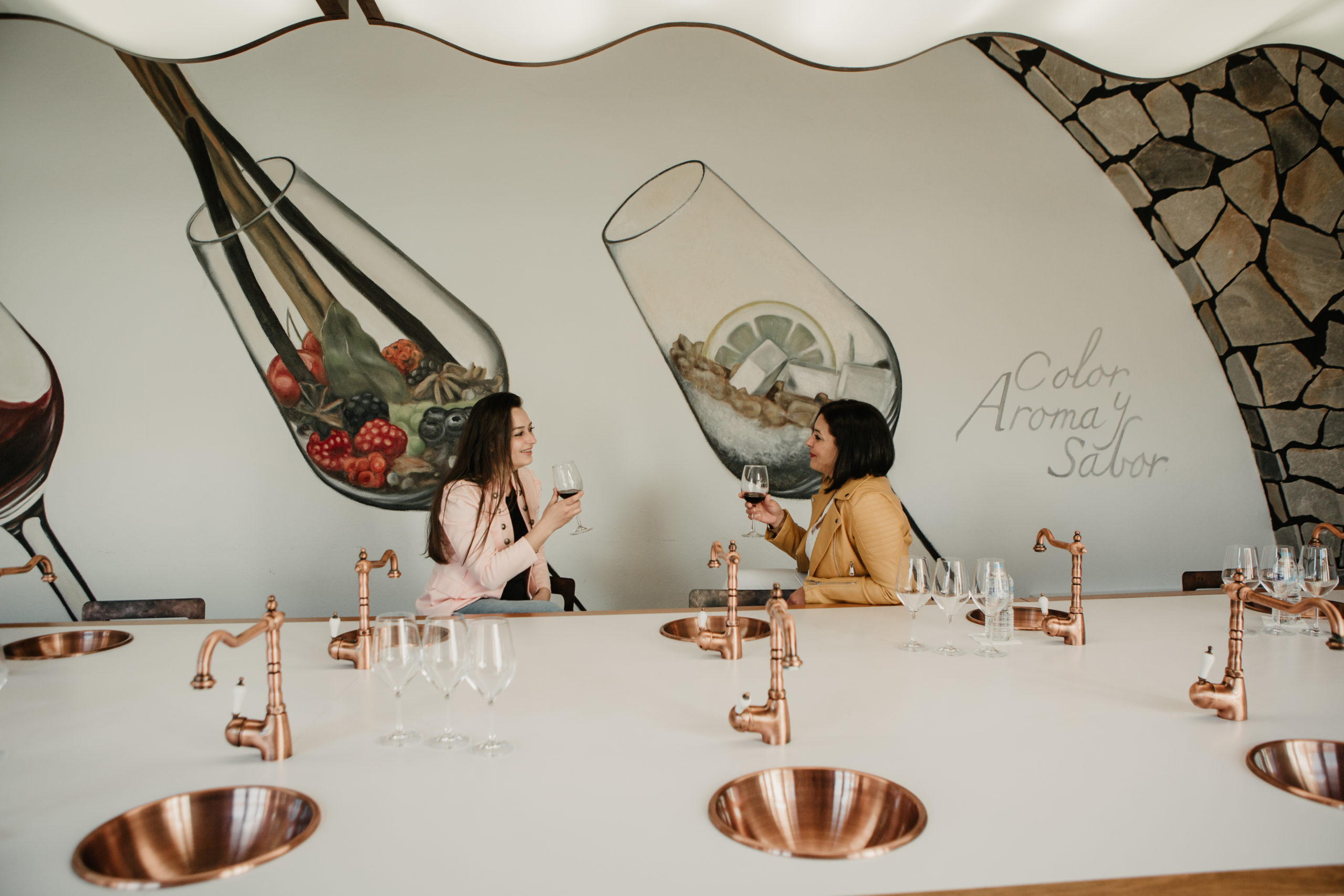
A curious factor comes into play here: expectation. A well-kept, clean, quiet, and professional environment puts us in a positive mood. And that also affects our perception of wine.
If the room is chaotic, the staff is running around, and there’s tension in the air, it’s difficult to surrender to sensory enjoyment. On the other hand, if everything is calm, the glasses sparkle, and the air smells clean, we enter tasting mode without even realizing it. It’s psychological. But real.
And let’s not forget the essential: the company with whom we share the wine
We could fine-tune all the technical aspects: controlling the wine’s temperature, eliminating any ambient odors, adjusting the natural light, and keeping the silence just right. But if we’ve learned anything after raising so many glasses, it’s that there’s one factor that changes everything: the company we share the wine with.
Because yes, wine is analyzed, evaluated, tasted… but above all, it’s shared. And that’s where something comes into play that can’t be measured with acidity meters or spectrophotometers: human connection.
Uncorking a reserve red wine amidst the laughter of friends isn’t the same as doing it alone on a random Tuesday. Nor does a crisp white wine taste the same as toasting a reunion in a sterile room. The wine experience is multiplied when emotions are involved, when conversation is taking place, when glances accompany each sip. Wine, like music or cooking, is a shared language. And if you experience it in good company, it becomes unforgettable.
We’re not just talking about romantic dinners or special celebrations. We’re also talking about a good chat with colleagues, a family meal, an impromptu get-together on the terrace. In all these moments, wine acts as a bridge. It unites. It opens. It connects.
So, if we’re asked how environmental conditions influence wine tasting, we can’t ignore this invisible but fundamental factor: the people we share it with. Because the best wine in the world is enjoyed even more if we drink it with someone who makes us feel at home.
In short: everything has an impact. A lot
How do environmental conditions influence wine tasting? They influence absolutely everything. From the moment we pour the glass until we take the last sip. It’s not just a matter of the palate or nose: it’s also a matter of light, noise, smell, temperature, and surroundings.
An excellent wine can go unnoticed if the setting isn’t right. And a modest wine can be enhanced if we taste it in a carefully curated setting. That’s why, when we organize a wine tasting, we leave nothing to chance. Because in the world of wine, the entire experience is just as important as the contents of the bottle.
So the next time you raise your glass, think about what’s around you, too. The environment isn’t a set. It’s part of the script.